
Custom drawer inserts
You enter the inside dimensions of your drawer and divide the compartments freely — we cut the parts to fit, you slot them together without glue. Or we glue them for you.
- · Divide compartments freely, right with your mouse
- · Fixed price and 3D preview in real time
- · MDF, birch plywood or corrugated cardboard
What is a custom drawer insert for?
Every drawer holds something different — and that decides the compartments. A few examples of how drawers can be divided:
 AI-generated
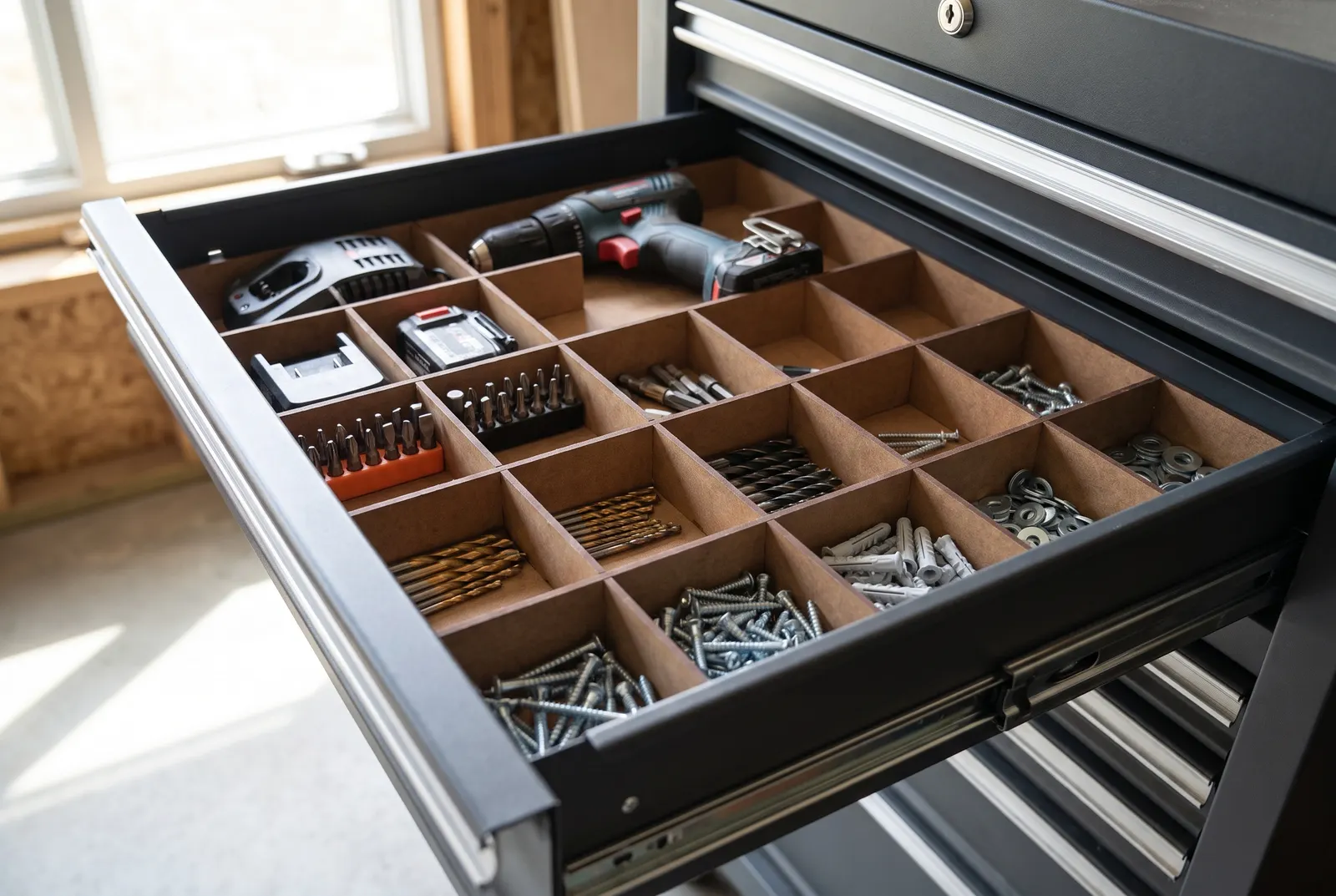
Workshop & tool cabinet
Cordless drill, charger, bits, drill bits, wall plugs and screws — every item in its own compartment. Large compartments for the tool and battery, small ones for parts sorted by length. 5 mm MDF keeps even heavy tool drawers rigid.
 AI-generated
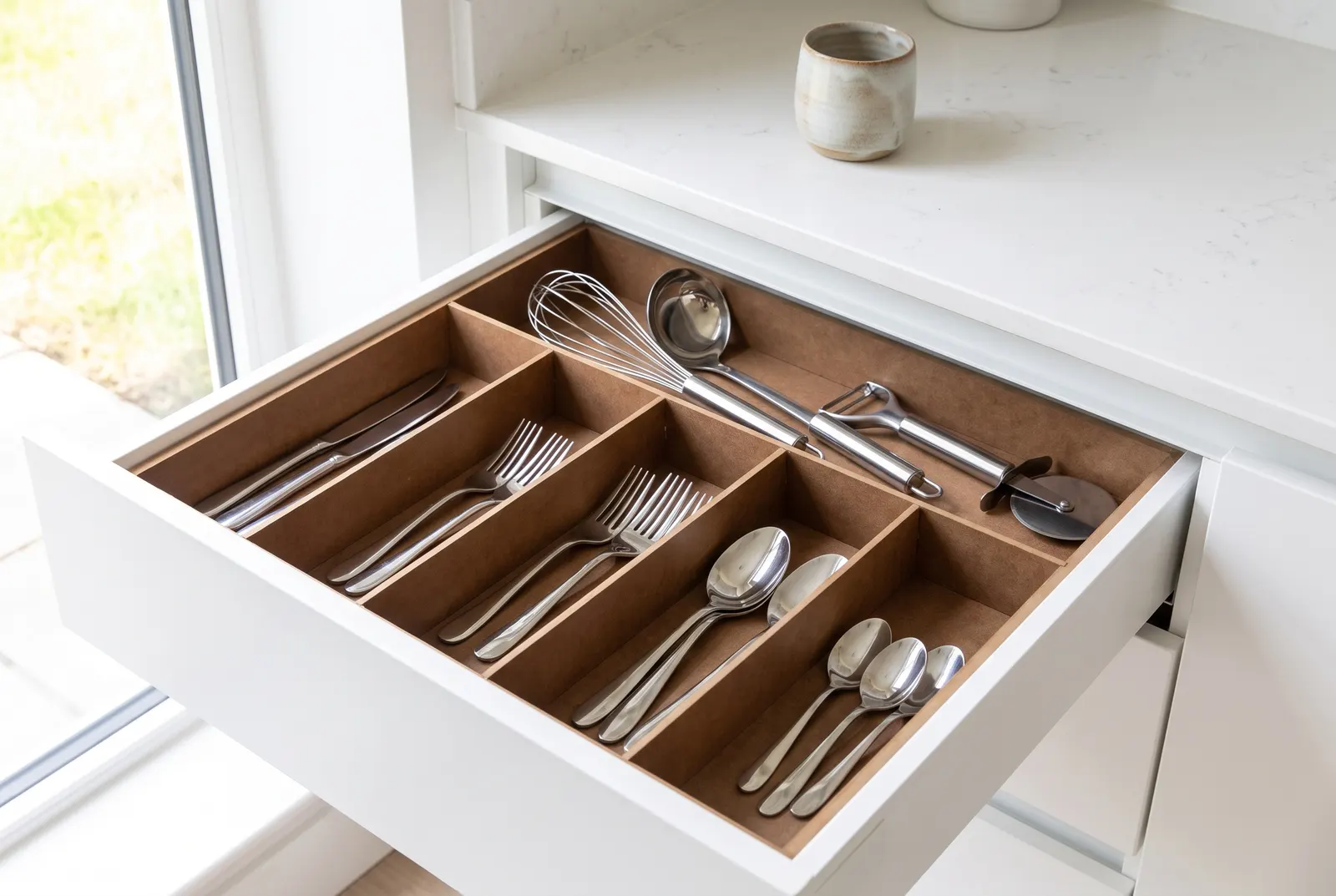
Cutlery & kitchen utensils
Long compartments for knives, forks and spoons, a cross compartment for whisk, ladle and pizza cutter. Fits kitchen drawers of any width — including ones with sloping side walls.
 AI-generated
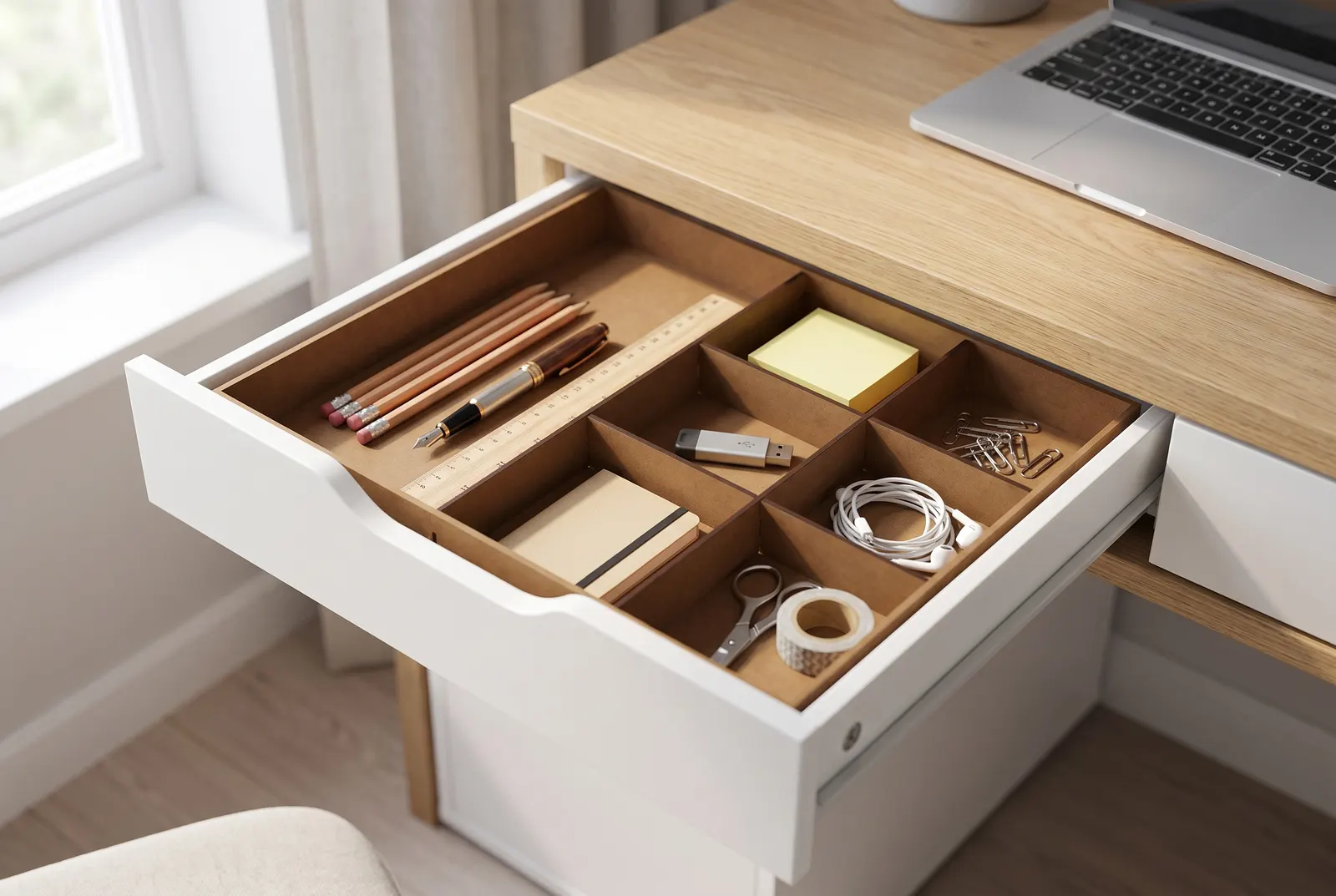
Desk & office
Pens, ruler, sticky notes, USB sticks, paper clips and charging cables — no more rummaging. Ideal for shallow desk and pedestal drawers.
 AI-generated
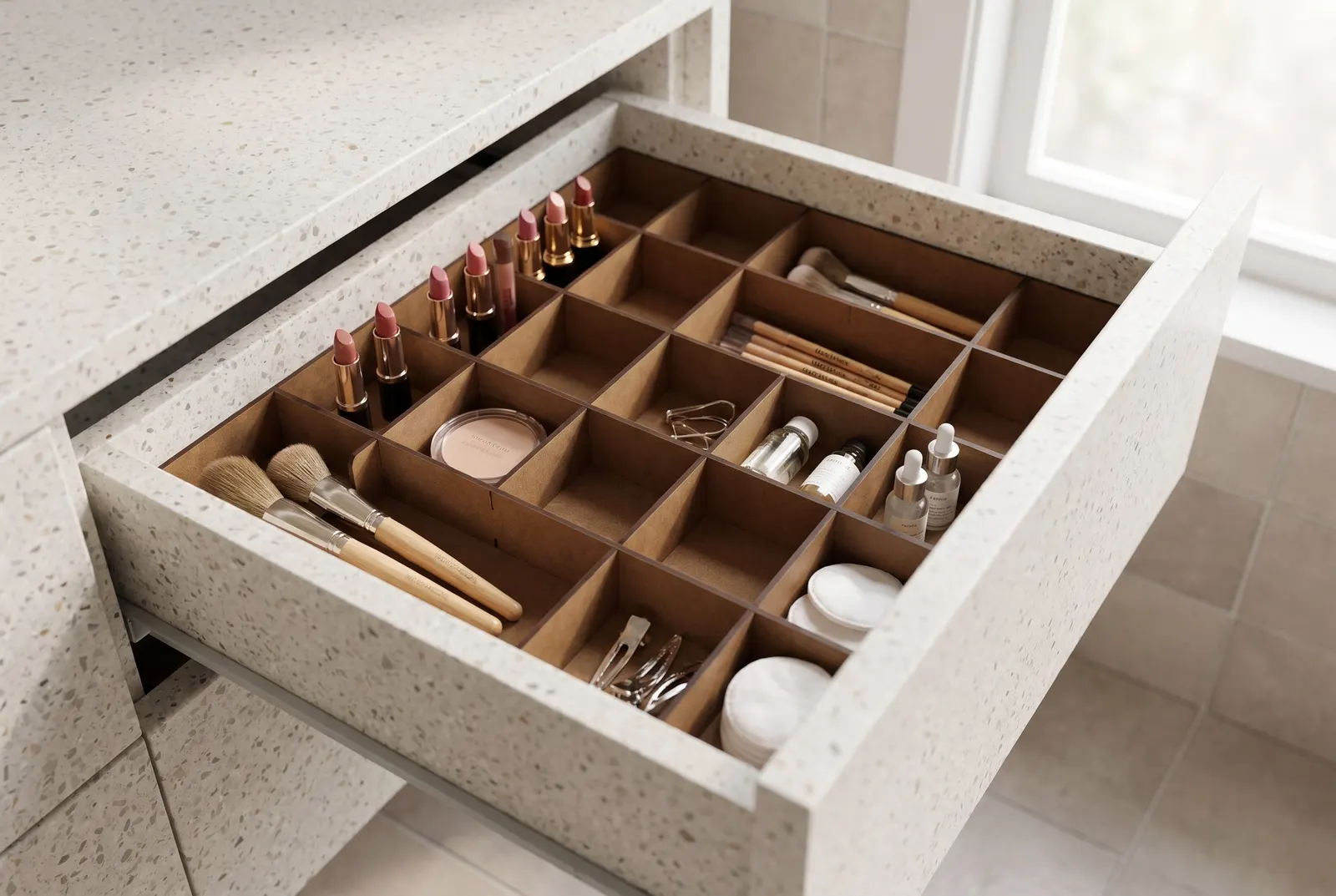
Bathroom & cosmetics
Lipsticks stand upright in narrow compartments, brushes lie flat, serums and creams have their fixed place. Glued, the insert lifts out in one piece for cleaning.
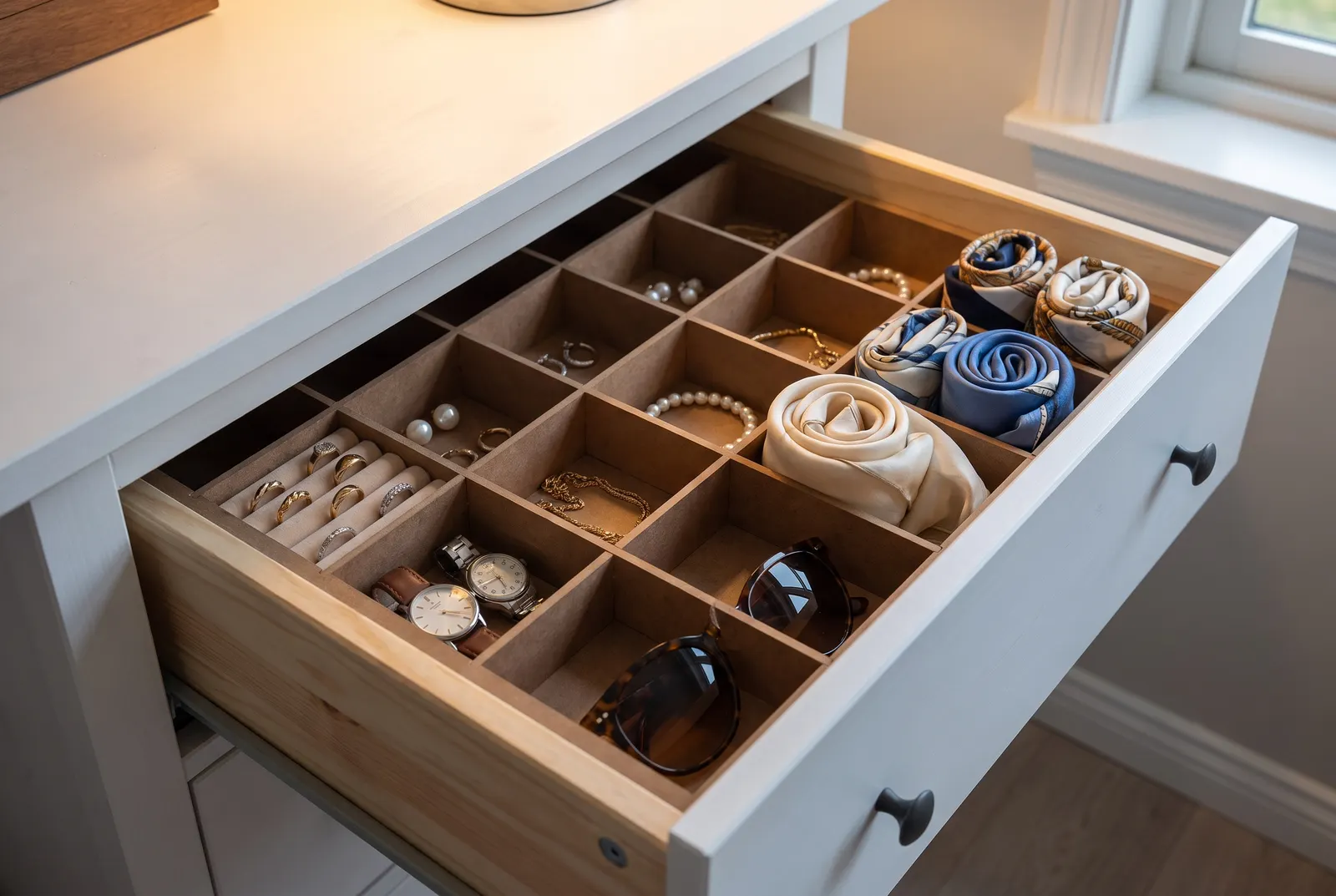 AI-generated
Jewellery, watches & accessories
Rings, necklaces, earrings, watches, sunglasses and scarves — small compartments for small things, large ones for rolled items. The bedroom chest of drawers becomes a jewellery drawer.
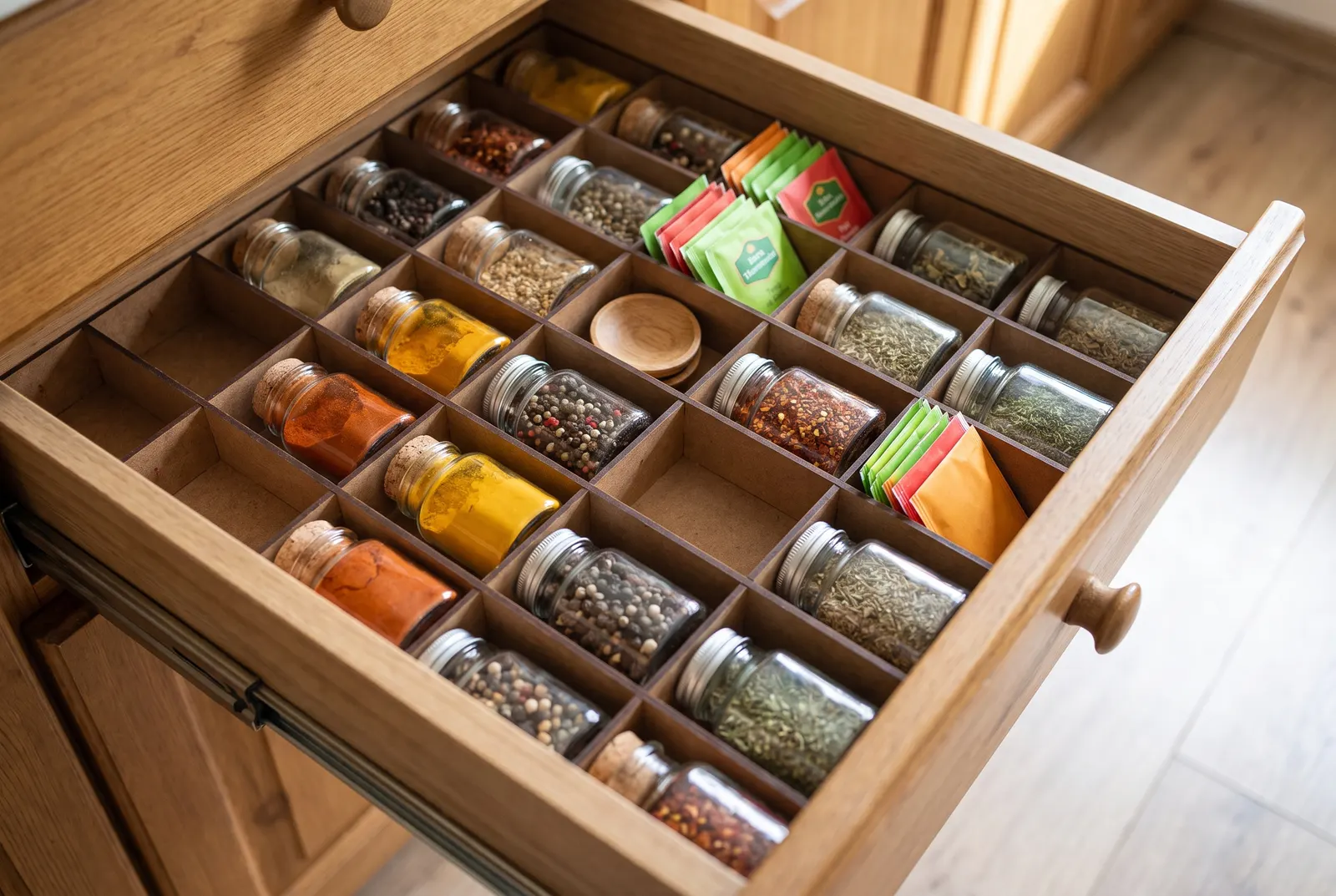 AI-generated
Spices & tea
Spice jars lie side by side in a tight grid, labels facing up, next to compartments for tea bags and sachets. You size the compartments to your jars.
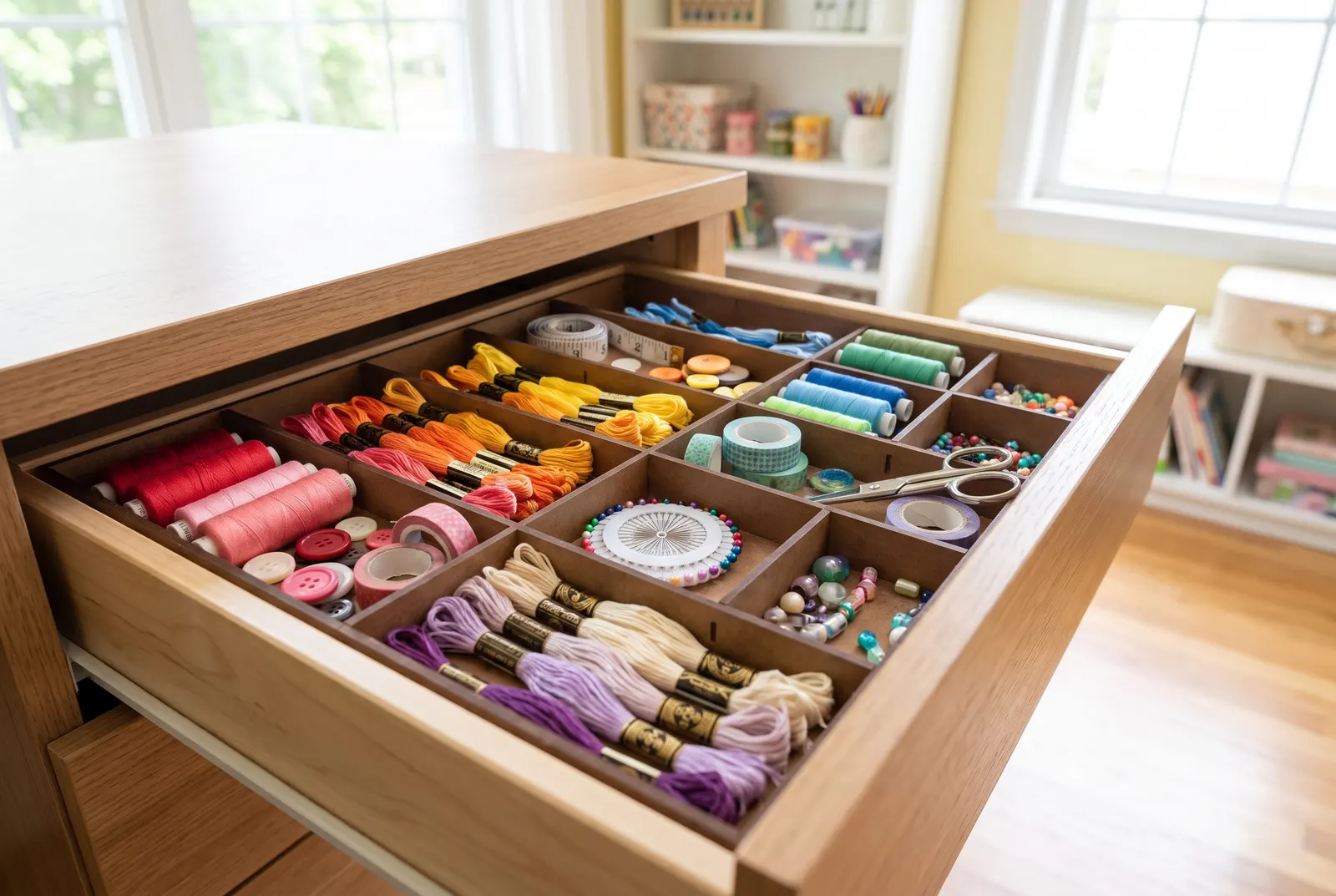 AI-generated
Sewing, needlework & crafts
Thread spools, embroidery floss, buttons, tape measure, beads and pin cushion — sorted by colour and visible at a glance. Just as good for craft, painting and model-making supplies.
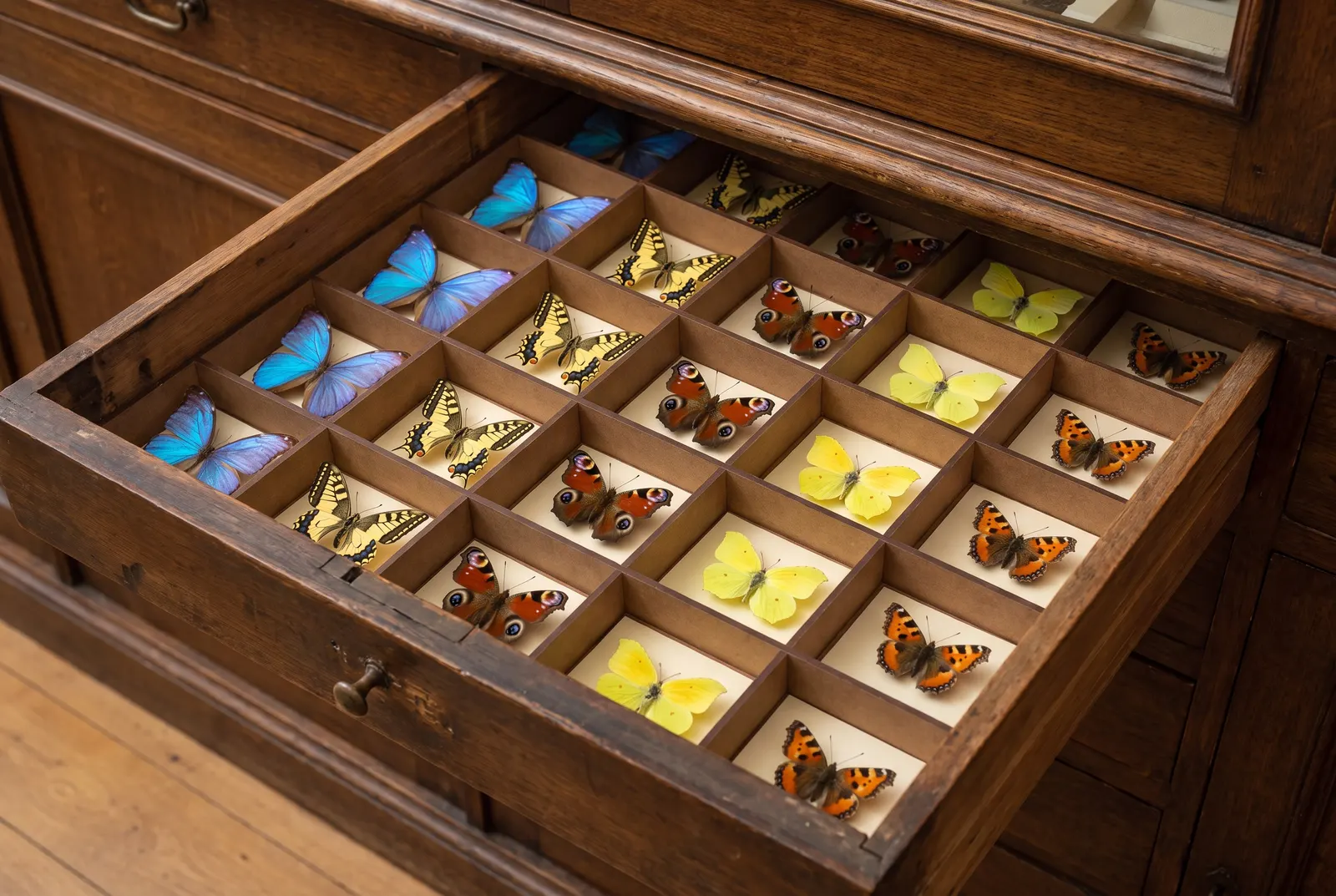 AI-generated
Collections: butterflies, minerals, coins
For collector cabinets and display drawers: equal compartments in a grid, every piece at a distance from the next. With a floor the collection rests on a smooth surface, and the labels help with cataloguing.
The photos in this section are AI-generated depictions for inspiration, not pictures of manufactured inserts. Dimensions, material and price from the configurator are what count.
Templates to start from
How it works
- 1
Measure
Measure the drawer inside at the bottom: width, depth, and the height you want the insert to have.
- 2
Divide
Choose a grid and remove dividers with your mouse until the compartments fit — or describe in the chat what should go inside.
- 3
Assemble
The parts arrive cut and, if you like, labelled. Dividers cross each other with slots, the frame is finger-jointed — slotted without glue or glued ready-made by us.
More ideas
Wherever small things get mixed up, a custom insert brings order:
- Electronics & cables
- Chargers, cables, adapters, power banks and batteries separated by type; for makers also resistors, sensors and breadboards.
- Toys & building bricks
- Bricks by colour or shape, figures, cards and dice — in the kids’ room or at the games table.
- Board games
- An insert made to the inside size of the game box keeps cards, tokens and figures sorted — set-up gets faster.
- First-aid kit
- Plasters, tablets, ointments and thermometer each in a fixed place — found at once in an emergency.
- Wardrobe
- Socks, underwear, belts and ties in their own compartments — wardrobe drawers stay tidy.
- Baking supplies
- Cookie cutters, piping nozzles, dough scrapers and pastry brushes sorted by size.
- Fishing & outdoor
- Hooks, floats, lures and lines in tackle boxes and gear drawers.
- Painting & drawing
- Watercolours, brushes, pencils and erasers by colour or hardness — ideal for plan chests.
- Model making
- Paints, brushes, blades, glue and parts — every little bottle in its place.
- Seeds
- Seed packets by sowing month or variety, upright in narrow compartments.
- Coffee & tea
- Coffee capsules and tea bags by type — in the drawer under the machine.
- Hallway & entrance
- Keys, sunglasses, gloves and dog lead within reach in the hallway cabinet.
Options in the configurator
With floor
A finger-jointed floor turns the dividers into a sturdy box. We cut large floors in pieces and join them with a puzzle joint.
Stackable
Small tabs on the top edge engage notches in the floor of the next insert — so you can stack two levels. We recommend 5 mm MDF.
Glued by us
Instead of slotting it yourself, you get the insert glued ready-made (MDF and birch plywood). The surcharge per glue joint shows in the price at once.
Labels
Small engravings such as A, 1 or FLOOR show where each part goes while you assemble.
Frame style
With a closed frame, with dividers passing through the frame, or with no frame at all — then only the dividers sit in the drawer.
Sloping side walls
If your drawer is wider at the top than at the bottom, the dividers get angled ends and still fit snugly.
Material & joints
MDF (3 or 5 mm) is smooth and dimensionally stable, birch plywood (3 mm) shows a lively grain, corrugated cardboard (2.5 mm) is light and affordable. Inside, the dividers interlock halfway up, comb into the frame, and the corners are finger-jointed.
Measuring correctly
Measure at the bottom of the drawer, not at the top edge — drawer slides and pull-out stops often protrude inward. The insert is made 1 mm narrower than your measurement on each side. Every insert is custom-made and excluded from the right of withdrawal.
Frequently asked questions
Which measurement do I enter?
The inside dimension of the drawer at the bottom. We subtract 1 mm of clearance on each side so the insert fits in without jamming.
Do I need to glue anything?
No. All joints are slotted together: cross-lap slots inside, a comb joint at the frame, and finger joints at the corners. If you would rather not assemble it yourself, order the insert glued by us.
How small can a compartment be?
At least 3 cm clear width — smaller than that a compartment can no longer be emptied, and the dividers need material between the slots.
How big can the insert be?
Up to 78 cm in width and depth and up to 15 cm in height — that way every part fits on one sheet.
Can I return the insert?
No — every insert is made to measure from your input; the right of withdrawal is excluded (custom-made goods).
Can I stack inserts?
Yes, with the “Stackable” option: tabs on top and matching notches in the floor hold two inserts on top of each other. The insert needs a floor and a closed frame for this; we recommend 5 mm MDF.
My drawer has sloping side walls — does that work?
Yes. Choose “No frame” and also enter the width at the top edge of the insert. The dividers get matching angled ends.
Can you deliver the insert glued?
Yes, in MDF or birch plywood. We glue every crossing and every finger in our workshop; the surcharge per glue joint is added in the configurator at once. Glued inserts come without labels.
What is a drawer insert good for?
For everything that would otherwise slide around: cutlery and kitchen utensils, spices, tools and screws, cosmetics, jewellery, office supplies, sewing kit, electronics, collections or toys. Because you divide the compartments yourself, the insert fits what you store.
How do I know which part goes where?
With the “Labels” option every part carries a small engraving (such as A, 1 or FLOOR) matching the numbering in the configurator.