
Display windows and viewing panes
On transparent parts you see every flaw — and every scratch. Most of them happen during assembly, not in use.
Reviewed on 31 August 2026
 AI-generated
Geometrically a pane is the simplest part there is — a rectangle, sometimes with holes. It is nevertheless among the most frequently reordered items, and the reason is rarely the contour. It is the properties of the material, which you notice immediately on a transparent part.
Scratches are the real issue
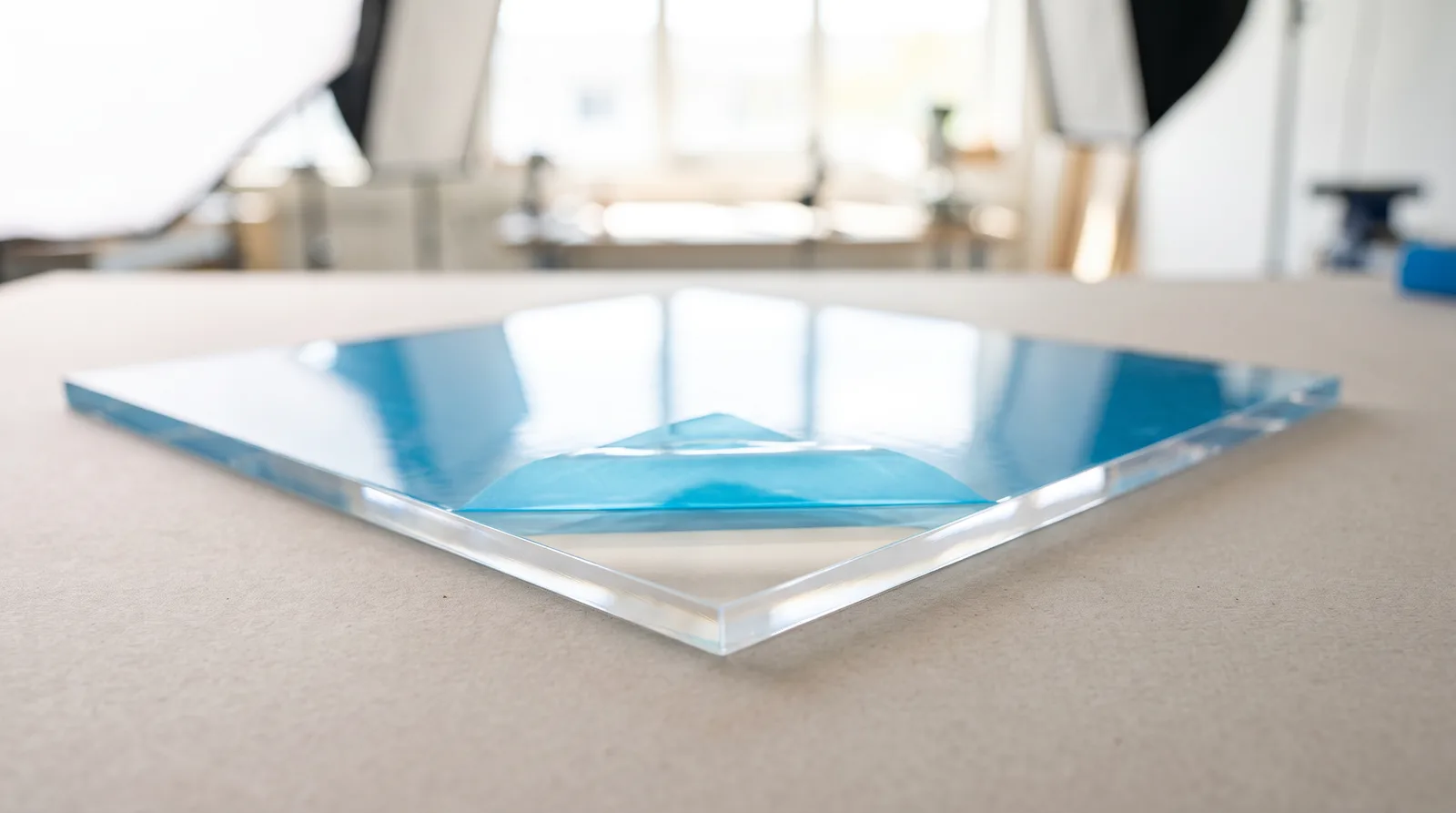
Acrylic is considerably softer than glass. A sleeve with a zip, a towel with a grain of sand, a bunch of keys on the workbench — that is enough. This is why acrylic comes from us with peelable protective film on both sides, and it should stay on as long as possible.
The practical advice from many builds: peel the film only when the part is in its final position, and if possible only on the side you are working on. Most scratches occur between unpacking and assembly, not afterwards.
Fine scratches can, incidentally, be polished out of acrylic — unlike glass. For deep scratches that is laborious; for the haze left by cleaning with the wrong cloth, a plastic polish is often enough.
Which thickness
For a display window sitting in a front panel and supported all round, 2 or 3 mm is enough. The pane carries nothing there; it only protects.
As soon as the pane spans freely — as a cabinet side, a cover hood or a divider — the area matters. As a rough guide: up to about 300 mm edge length 3 mm, above that 5 mm, and for large free-standing areas or where someone might lean on it, rather 8 mm. Acrylic bends a long way before it breaks, but a visibly sagging pane looks cheap.
With cabinets, also bear in mind the dead weight: acrylic is lighter than glass, but an 8 mm sheet at cabinet size is still not something a thin slotted joint will hold permanently.
Clear, frosted or anti-glare
Clear acrylic is optically the most unobtrusive but reflects like glass. In front of a display read in a bright room that can be a nuisance — frosted or anti-glare material is then the better choice, even if it costs a little contrast.
Frosted material has a second advantage: it barely shows fingerprints. For anything that gets touched — control panels, covers on devices — that is often more pleasant than a high-gloss surface.
For viewing windows lit from behind the opposite applies: there scattering is desirable, so that individual light sources do not show through as points.
Replacement panes
If you are replacing an existing pane, do not measure the pane — measure the opening it belongs in and add the clearance yourself. The old pane may be warped, reworked or inaccurate from the start.
The safest way to transfer holes is to lay the old pane on as a template and mark the hole centres. And plan the holes somewhat larger than the screw shank: acrylic expands with temperature considerably more than metal does, and a tightly bolted pane is permanently under stress.
Frequently asked questions
- What thickness does a display window need?
- Supported all round in a front panel, 2 to 3 mm is enough. Freely spanning panes from about 300 mm edge length rather 5 mm, large or loaded areas 8 mm.
- When should I peel off the protective film?
- As late as possible — ideally only once the part is mounted. Most scratches occur between unpacking and installation.
- Can scratches be removed from acrylic?
- Fine scratches and haze can be polished out with plastic polish — an advantage over glass. Deep scratches require sanding through several grits and a lot of patience.
- Clear or anti-glare for a display?
- Clear is optically neutral but reflects. In bright rooms or at a shallow viewing angle, frosted material is more comfortable; backlit windows need scattering anyway.
Sources
- Our own production: display windows, cabinet and replacement panes, 2019–2026
- Order analysis from 2019: 129 customer profiles relating to panes or covers (EUR 40,242)