
Slotting, screwing or gluing
Cutting is quick; durability is decided during assembly. Acrylic forgives less than wood does.
Reviewed on 31 August 2026
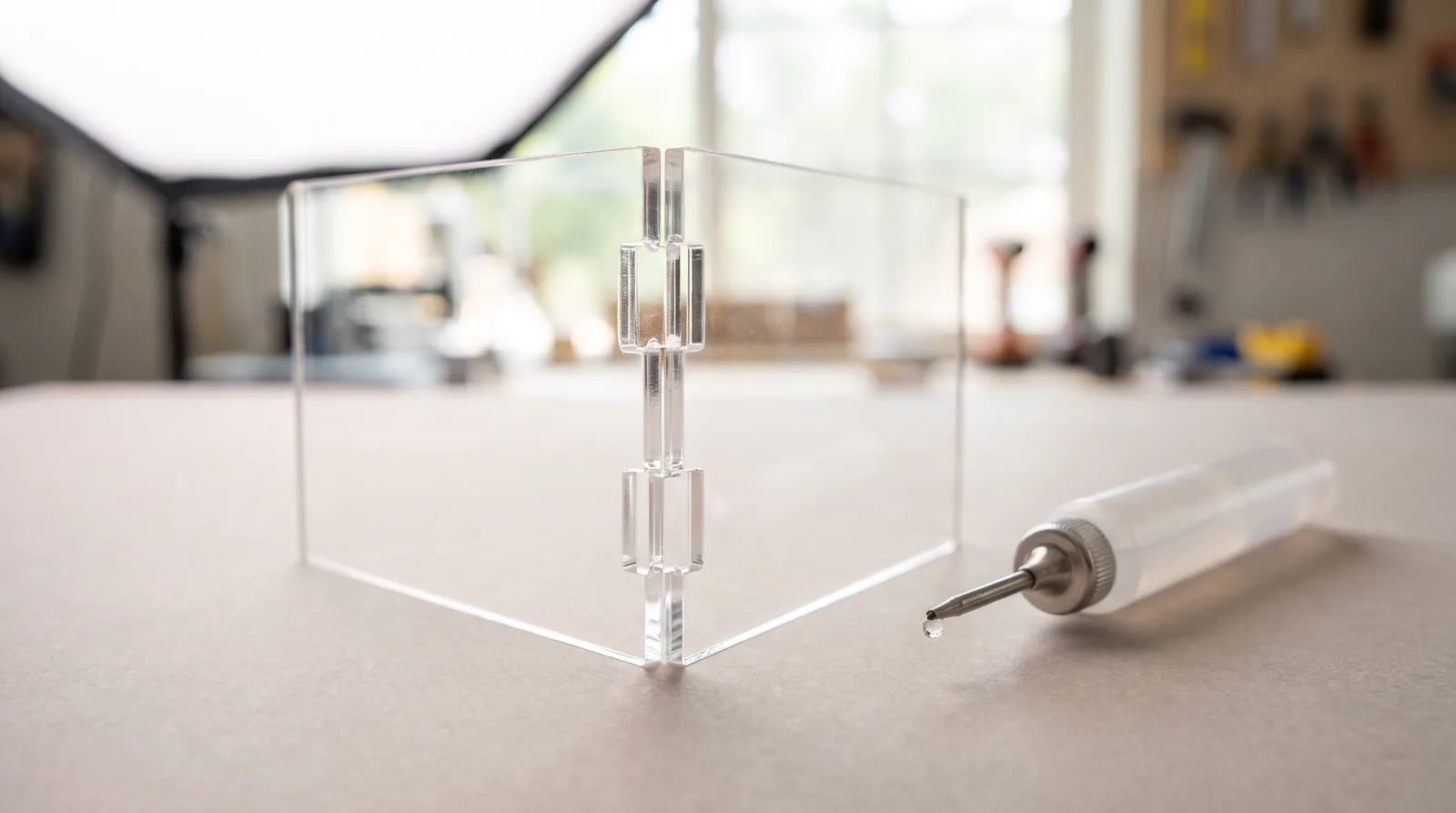 AI-generated
For panel constructions from the laser there are essentially three routes: slotting, screwing, gluing. They are not mutually exclusive — the most durable builds usually combine two of them.
The three routes compared
| Joint | Strengths | Limits |
|---|---|---|
| Slotting (tab and slot) | aligns itself, needs no accessories, can be taken apart again | always has play from the kerf, does not hold permanently on its own |
| Screwing | removable, insensitive to tolerance, ideal for service hatches | needs threaded inserts or nuts; acrylic itself holds no thread |
| Gluing | invisible joint, very strong in acrylic, seals as well | final, forgives no rework, adhesive choice depends on material |
Gluing acrylic
Acrylic is not really glued but welded. The classic route is a thin solvent-based polymerisation cement that softens the surfaces and bonds them to one another. It is not applied but drawn into the already closed joint with a needle bottle, where capillary action distributes it.
This presupposes clean, flat edges — which lasering does well, since the cut edge is smooth and slightly flame-polished. What the method does not forgive is play: where the joint gapes, no strong bond forms. For gap-filling tasks there are more viscous two-component variants.
Two points from practice: the protective film stays on the material until immediately before gluing and is pulled back only at the bonding face. And work with good ventilation — the solvents are volatile.
Stress cracks — the invisible fault
Acrylic reacts sensitively to internal stress in combination with solvents. A part forced into a groove that is too tight, or clamped by over-tightened screws, is permanently under stress. Add a solvent — from adhesive, cleaner, or merely from glass cleaner during cleaning — and fine hairline cracks form.
Prevention is easier than repair: design joints so that nothing sits under constraint, tighten screws only finger-tight, make holes somewhat larger than the screw shank, and use no alcohol- or ammonia-based products for cleaning.
Screwing into sheet material
A thread cut directly into acrylic strips the first time it is tightened firmly. There are three viable alternatives: through-bolts with a nut on the back, threaded inserts for bonding in, or a glued-on strip of thicker material to screw into.
With wood-based materials the situation is more relaxed — a wood screw will hold in plywood and MDF. But there too: pre-drill, or the panel splits at the edge.
What works best in combination
The most robust construction for an enclosure combines finger joints with adhesive: the fingers align the parts and hold them in position while it cures, the adhesive fills the play from the kerf and makes the corner solid. The lid stays screwed so that you can get back inside.
For prototypes and anything still subject to change, plain slotting with screws at the corners is the better choice — glued is final, and on a first build something rarely fits perfectly.
Frequently asked questions
- What do you use to glue acrylic?
- A thin solvent-based polymerisation cement drawn into the closed joint, which welds the parts together. For gap-filling joints there are more viscous two-component variants.
- Why does my acrylic turn white at the bonded area?
- That is almost always superglue. Cyanoacrylate fogs the surface and encourages stress cracks. Acrylic needs a polymerisation cement in the joint, not superglue.
- Can I cut a thread in acrylic?
- Better not — acrylic is brittle and the thread strips. Use through-bolts with a nut, threaded inserts, or a glued-on strip with a hole.
- Where do the fine cracks in my part come from?
- From the combination of mechanical stress and solvent. Parts mounted under constraint crack as soon as adhesive or cleaning agents act on them. Make holes generous, tighten screws only finger-tight and use mild cleaning products.
Sources
- Our own production and customer advice, 2019–2026
- PLEXIGLAS processing guideline 311-3 “Joining PLEXIGLAS”
- PLEXIGLAS® Verarbeitungsrichtlinie 311-3 — Fügen von PLEXIGLAS (retrieved 7 September 2026)