
Plates for custom keyboards
On a switch plate a tenth of a millimetre decides whether the switches click in or wobble.
Reviewed on 31 August 2026
 AI-generated
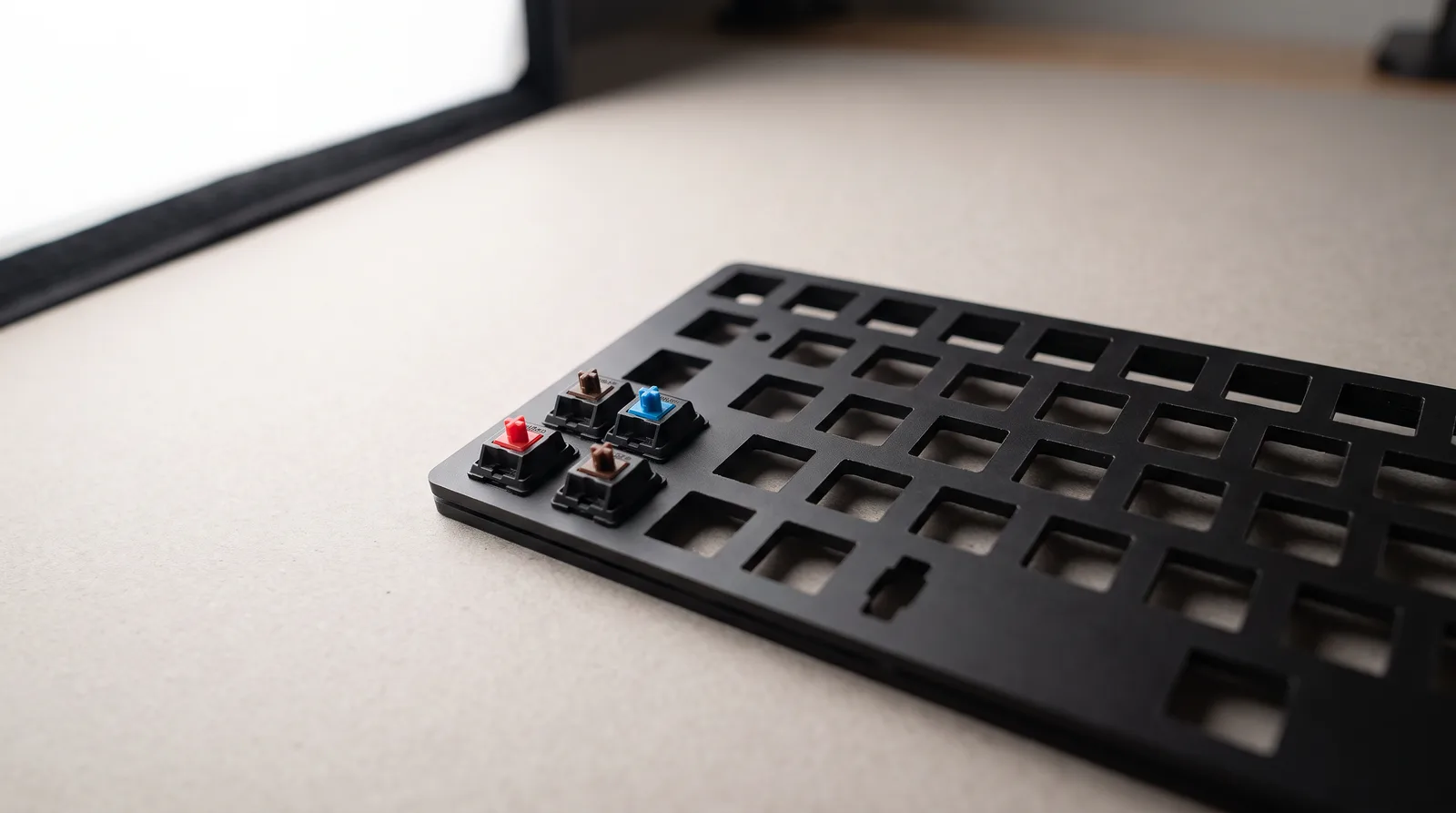
A switch plate is a panel with one square cut-out per key. The switches clip into it with their side latches and are thereby held independently of the circuit board — which makes the keystroke firmer and the typing feel more even.
The standard dimension for the cut-out is 14 × 14 mm. That is not an arbitrary figure but the size at which the latches of an MX-compatible switch engage. Precisely for that reason the kerf is not a detail here but the decisive factor.
Thickness determines the typing feel
For the latches of an MX switch to grip above and below, the plate has to be around 1.5 mm thick. Any thicker and the latches no longer engage properly; any thinner and the switch sits loose and can pull out with the keycap.
If you deliberately want more flex, work with thinner material or with additional cut-outs between the rows rather than a closed surface. Acrylic is more brittle than metal — generously cut flex patterns can break under heavy typing.
Layout files
You do not have to design the positions of the cut-outs yourself. It is common practice in the scene to compose the layout in one of the widespread editors and have a generator produce a plate drawing as a vector file from it.
What these generators do not do for you: they do not know our kerf. Some offer a correction value — then enter it. If they do not, correct the cut-outs afterwards in your drawing program before uploading the file.
Case panels
Besides the switch plate, the case parts are often cut at the same time — base, frame layers and top as stacked panels joined by through-bolts. This sandwich construction is ideal for sheet material because it manages without finger joints and can be adjusted freely in height.
For the looks it pays to think about the visible edges: with transparent acrylic you see every layer from the side. If you use that, combine colours deliberately; if you do not want it, use opaque material for the intermediate layers.
Frequently asked questions
- How large does the cut-out for an MX switch have to be?
- The target dimension is 14 × 14 mm after cutting. Therefore draw one full kerf smaller — around 13.65 mm with 3 mm acrylic.
- What plate thickness for a switch plate?
- Around 1.5 mm, so that the latches of the switches grip above and below. Thicker prevents them clipping in, thinner lets the switches wobble.
- Can I upload a file from a layout generator directly?
- Check the kerf correction first. Many generators offer a field for it; without correction the cut-outs come out too large and the switches will not hold.
Sources
- Our own production: switch plates and case panels for custom keyboards, 2019–2026
- Order analysis from 2019: 61 customer profiles relating to keyboards (EUR 10,407)