
Which material thickness
Thickness decides stability, price and appearance — and in slotted constructions it is a design dimension as well.
Reviewed on 31 August 2026
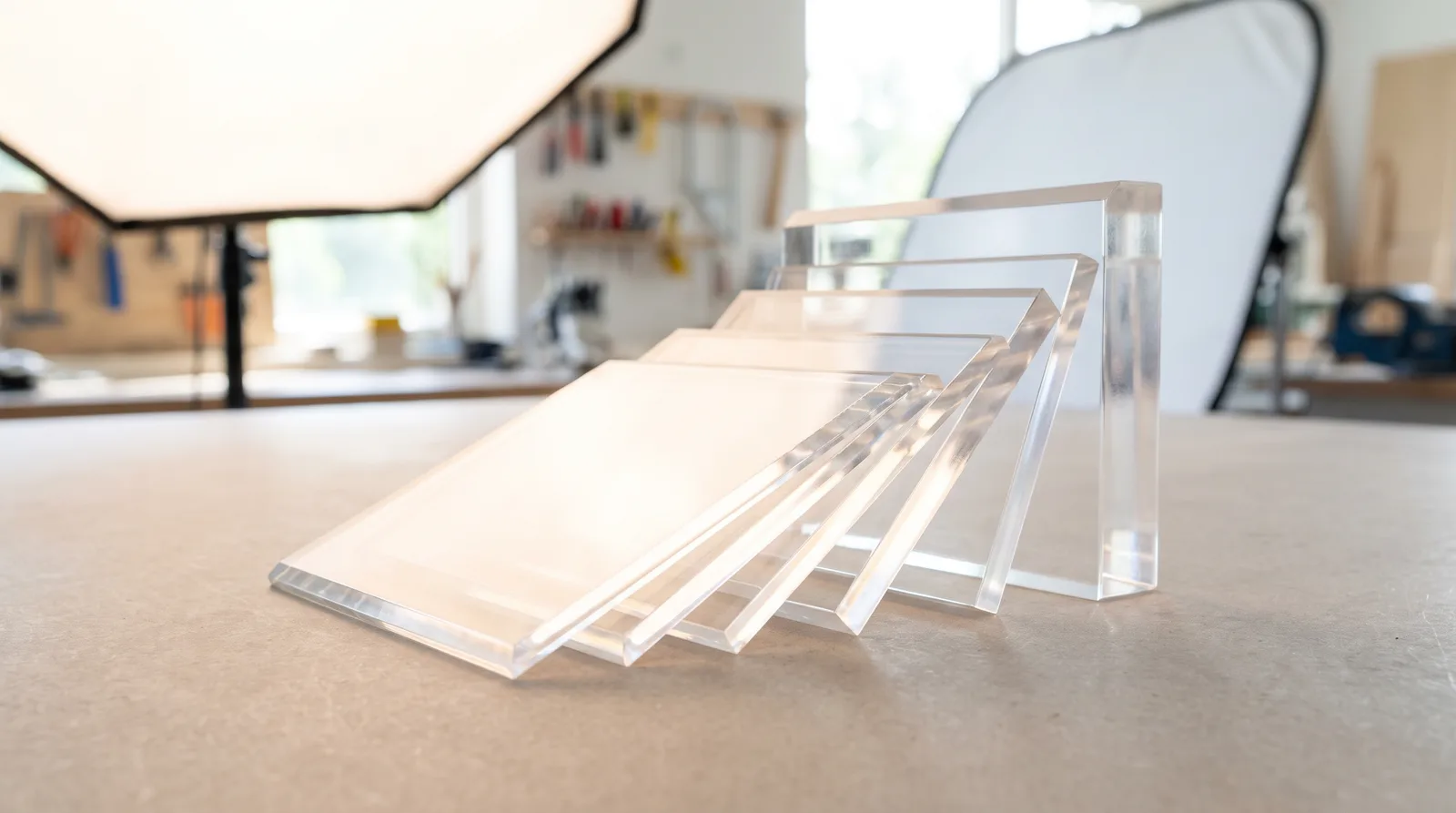 AI-generated
Looking at our own production, the answer is unambiguous: almost half of all parts that go through our laser are 3 mm thick. Some way behind follow 5 mm and 2 mm. That is no coincidence — 3 mm is the point at which a part is stable enough to carry something and still thin enough to stay affordable.
Deflection grows faster than you think
The stiffness of a panel does not increase linearly with thickness but roughly with its third power. A 6 mm panel is therefore not twice as stiff as a 3 mm one but roughly eight times. Conversely: the step from 3 to 5 mm achieves far more on a sagging shelf or cabinet side than the numbers suggest.
The unsupported span matters just as much. A panel seated in a groove all round carries considerably more than the same panel resting on two edges only. If you want to avoid deflection, changing the support is often better than changing the thickness.
Why thicker costs disproportionately more
The price of a cut consists of material and processing. The material becomes more expensive with thickness — that is expected. Less obvious is the second component: thicker material has to be cut more slowly, because the beam needs more time to work through. So the pure cutting time rises as well.
On a part with a lot of contour — delicate patterns, many holes, long cutting paths — this component weighs more heavily than the material itself. An elaborate ornament in 8 mm therefore costs a multiple of the same ornament in 3 mm.
Practical consequence: if a part has to be thick but has a lot of contour, a layered construction is often worthwhile — several thin layers on top of one another instead of one thick panel. With sheet material that is a common construction anyway.
Thickness as a design dimension
In anything that slots together, material thickness is not merely a stability parameter but feeds directly into the dimensions: every slot is as wide as the opposing wall is thick, every finger depth corresponds to it. Change the thickness afterwards and you have to adjust half the drawing.
That is why the decision belongs at the beginning, not at the end — together with a look at the thickness tolerance of the chosen material.
Limits below and above
At the lower end, handling sets the limit: very thin parts warp, bend when removed and, with delicate contours, need holding tabs so they stay in the rest of the sheet. At the upper end the process sets it — with very thick plastic sheets the cut edge becomes increasingly angled and quality suffers.
If you are unsure, a small sample in two thicknesses is the fastest way to decide. Paper lies about stiffness; in the hand you notice immediately whether it is enough.
Frequently asked questions
- Which material thickness should I choose?
- 3 mm is the standard and covers most applications — almost half of all parts we produce have that thickness. Move to 5 mm as soon as something spans freely, takes load or becomes longer than about 300 mm.
- How much stiffer is 5 mm than 3 mm?
- Considerably more than the numbers suggest: stiffness grows roughly with the third power of thickness. The step from 3 to 5 mm achieves a great deal against deflection.
- Why does thicker material cost disproportionately more?
- Because not only is the material more expensive, it also has to be cut more slowly. On parts with a lot of contour, cutting time weighs more heavily than the material.
Read on
Sources
- Our own production: material distribution across 825 production files with 2,063 parts
- Manufacturer material data sheets