
Sample first, then the run
A considerable share of our regular customers order a small test sheet first. That is not fussiness but good practice.
Reviewed on 31 August 2026
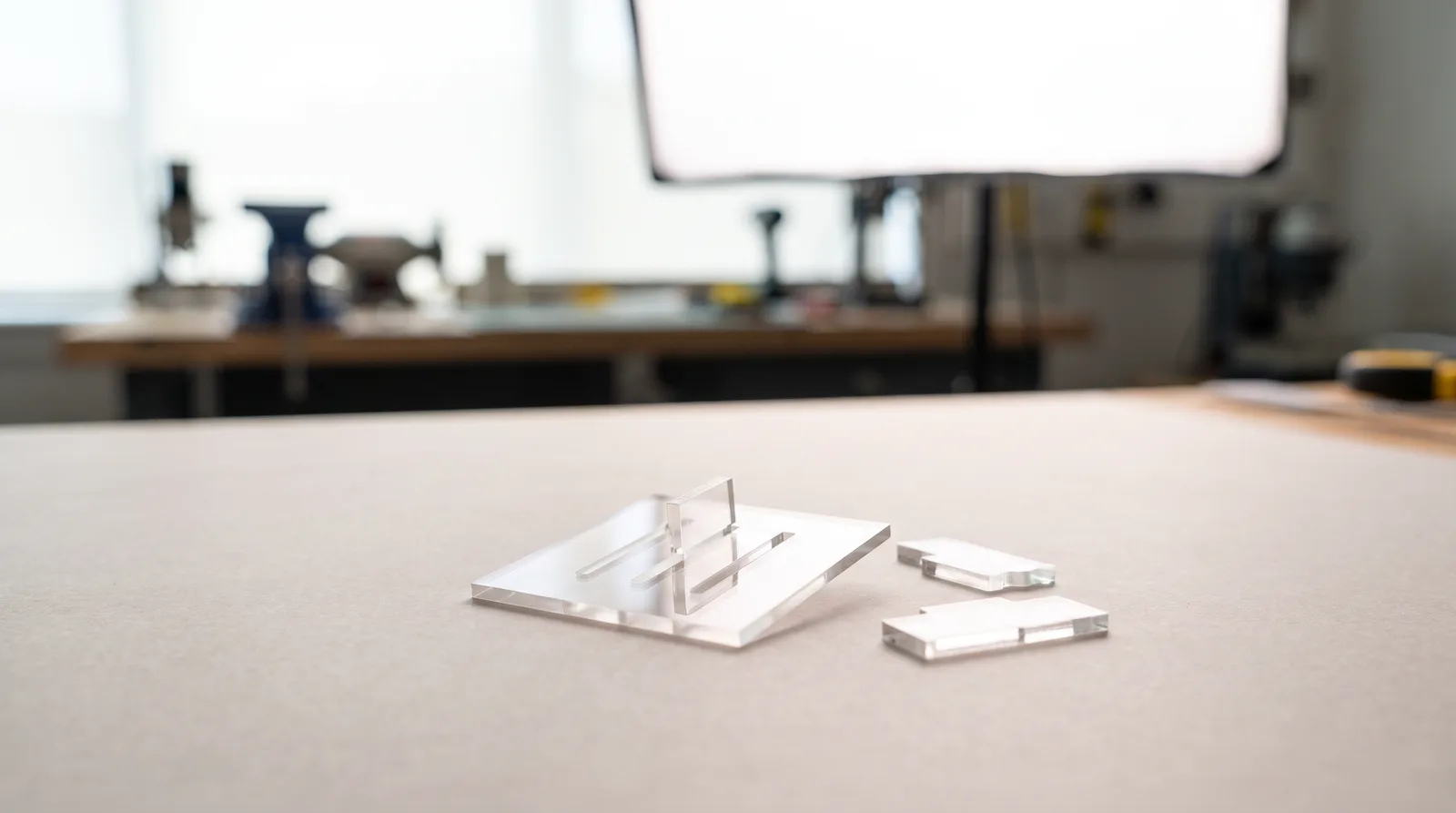 AI-generated
Looking at how repeat orders typically begin, a pattern emerges: before the actual run there is often a small cut — a strip, a corner piece, a single part. Only then comes the real order.
That is no coincidence and no beginner’s caution. It is the realisation that three things cannot be judged on screen: how the material feels, whether the fit sits, and how the engraving looks.
What belongs on a sample sheet
Use the area for several questions at once. A sensibly filled sample sheet answers in one pass what would otherwise need three orders.
For the fit: a strip with the same slot in three widths — nominal, half a kerf narrower, a full kerf narrower — plus a matching tab. That gives you your correction value for this material.
For the appearance: the same lettering once as vector and once as raster engraving, plus the smallest type size you intend to use. That way you see before the run whether the contrast carries and the type stays legible.
For the design: the most critical detail of your drawing — the tightest spot, the most delicate web, the smallest hole. Not the whole part, only the point you are unsure about.
Comparing materials
If you are torn between two materials or two thicknesses, you will decide fastest with both in your hand. Stiffness cannot be read from a table — you notice in a second whether a panel is enough for the purpose.
The same goes for colours and surfaces. A shade on screen is an approximation; matt or glossy, translucent or opaque is decided on the real piece under the light the part will later stand in.
When you can do without it
Not every part needs a run-up. With a simple contour without fits, in a material you already know, the sample cut is dispensable — a sign, a cover, a decorative part.
But as soon as two parts interlock, a run goes beyond a few pieces, or the material is new to you, the arithmetic reverses. Then the sample cut is the cheapest line on the whole order.
Frequently asked questions
- Is a test cut worthwhile?
- As soon as parts interlock, a run is coming up or the material is new to you: yes. A sample piece on the smallest format costs a fraction of a faulty batch.
- What should I order as a sample?
- Not the whole part but the critical points: a fit strip with three slot widths, your lettering in both engraving types and the most delicate detail of your design.
- Can I compare different materials?
- Yes, and it is the fastest way to decide. Stiffness, surface and colour effect cannot be judged on screen — in the hand it takes a second.
Sources
- Order analysis from 2019: 82 customer profiles explicitly relating to tests or samples (EUR 23,667)
- Our own production and customer advice