
Which material survives outdoors
Of our range, essentially one single material is suitable for permanent outdoor use. That is the short and honest answer.
Reviewed on 31 August 2026
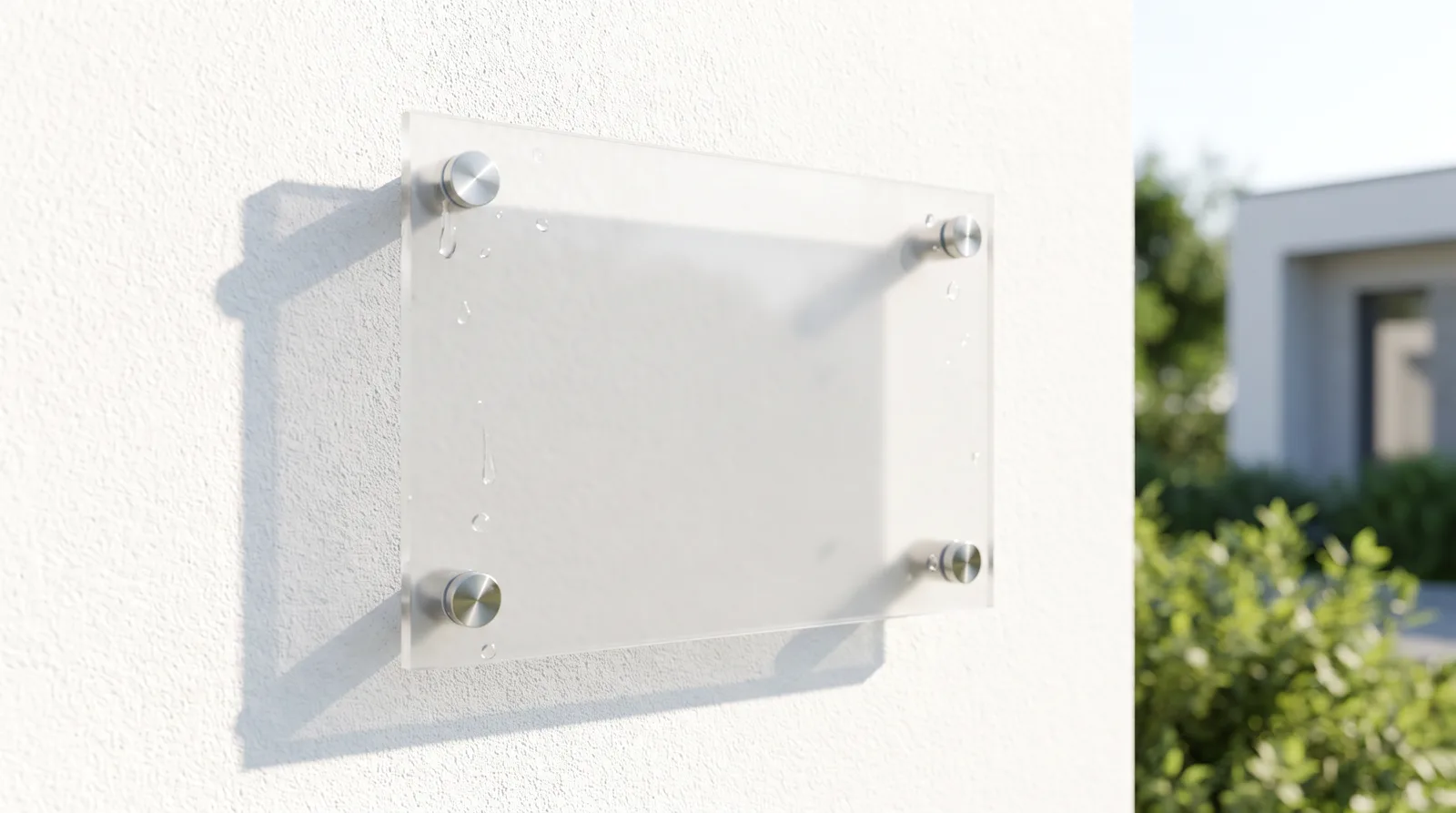 AI-generated
Outdoors, four things act at once: UV radiation, moisture, temperature cycling and frost. Each on its own is manageable; together they sort a material range very quickly.
We would rather say this beforehand than afterwards: the greater part of our catalogue is not made for outdoor use. That is not a question of quality — photo board and felt are excellent materials, just not in the rain.
Suitability by material
| Material | Outdoor use | Why |
|---|---|---|
| Acrylic, cast and extruded | suitable | UV-stable, does not yellow, waterproof, frost-resistant |
| PET-G, polypropylene | limited | waterproof, but less UV-stable — yellows or becomes brittle |
| Silicone | limited | weatherproof, but intended as a seal, not as a structural part |
| MDF, plywood, veneer | not suitable | swell, delaminate, the glue does not withstand moisture |
| Finnboard, card, photo board, corrugated board | not suitable | absorb water and lose all strength immediately |
| Kraftplex | not suitable | cellulose material — warps and softens |
| Felt, cork, leather | not suitable | take up moisture, grow mould, freeze solid |
In short: if it is to stay outdoors permanently, acrylic is the answer.
Mounting with room to move
This is the mistake that most often happens outdoors: the panel is bolted down tightly at several points. As long as the temperature stays the same, that holds. On the first hot day the material wants to expand but cannot — and cracks at the hole.
The solution is simple: make holes considerably larger than the screw shank, use washers, and tighten only enough to hold the panel while still letting it slide. For longer parts, slotted holes are worthwhile. And one point may fix the panel — all the others have to be free to move.
For small parts such as house numbers this is uncritical; from around half a metre of edge length it should be planned for.
What happens over time anyway
Acrylic does not yellow, but it remains scratch-sensitive — a façade panel within reach will show signs of use over the years. It can be cleaned with water and mild washing-up liquid; alcohol- or ammonia-based glass cleaners are taboo, because together with mounting stress they trigger hairline cracks.
Engravings hold up well outdoors but fill with dirt over time — which can even improve contrast. If you want a permanently light engraving, two-colour material serves you better than a coloured-in recess.
What we do not offer
Classic outdoor advertising — large-format signs, construction-fence banners, façade lettering — usually uses aluminium composite panels or printed films. We stock neither and do not cut them either: aluminium facings are not suitable for our lasers.
What we do well is individual, precise parts in acrylic — house numbers, door signs, name plates, covers. For anything large-format, a sign maker is the right address.
Frequently asked questions
- Which material is weatherproof?
- From our range essentially acrylic — UV-stable, waterproof and frost-resistant. Wood-based materials, boards, felt, cork and leather are not suitable for permanent outdoor use.
- Does acrylic yellow in the sun?
- No. PMMA is the most UV-stable of the common transparent plastics and stays clear even after years outdoors — unlike polycarbonate or PET-G, for example.
- Why does my acrylic sign crack at the screws?
- Because it expands with temperature and cannot move. Make holes larger than the shank, use washers, tighten only finger-tight — and provide slotted holes on long parts.
- Can I make plywood weatherproof with varnish?
- Only to a limited extent. Varnish protects the surface, but the cut edges and holes remain weak points where water penetrates and the plies delaminate. For permanent outdoor use, acrylic is the more reliable choice.
Read on
Sources
- Manufacturer material data sheets (PLEXIGLAS processing guidelines 311-1 to 311-5)
- Our own production: house numbers and outdoor signs in acrylic