
PET-G
1 variant, thicknesses: 0.5 mm. Cut on the P1–P3 and Q formats, price shown live while you design.
- Laser cutting
- Vector engraving
- Raster engraving
- Bendable up to 0.5 mm
kerf
The laser vaporizes material — the cutting gap varies with material and thickness. Cuts run centered on the drawn line; for shape.tools products we factor the kerf into your dimensions automatically.More in the glossary →P1–P3 and Q sheet formats
Our four sheet formats: P1 = 181 × 181 mm, P2 = 384 × 384 mm, P3 = 790 × 384 mm, Q = 900 × 450 mm. Your design has to fit on one of the sheets. For scale: a vinyl record cover sits between P1 and P2.More in the glossary →
How PET-G lasers
Standardised photos of the real material — same motifs, same light, so you can compare materials.
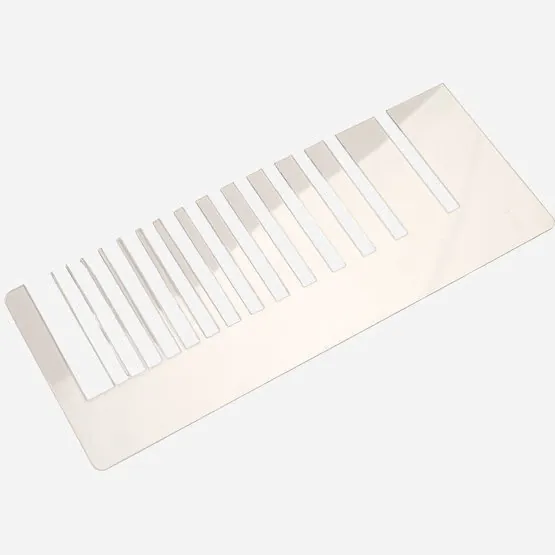
Test cuts 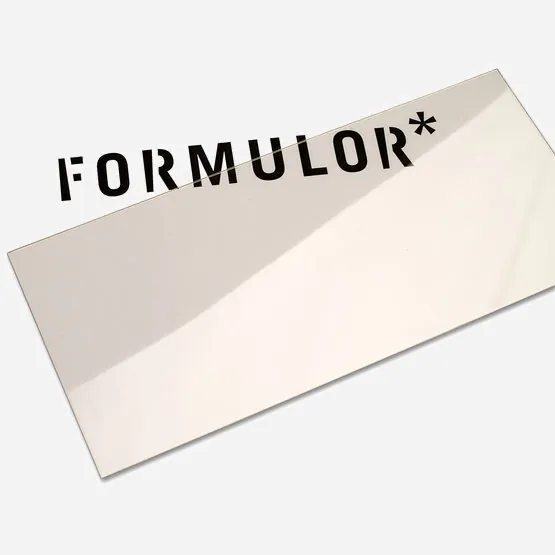
Transparency 
Top view 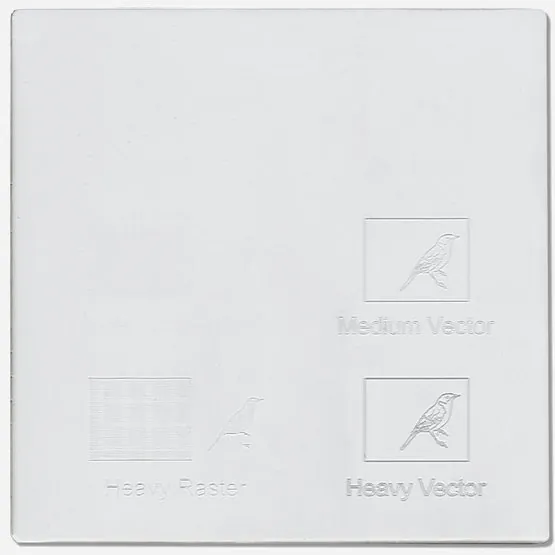
Engraving 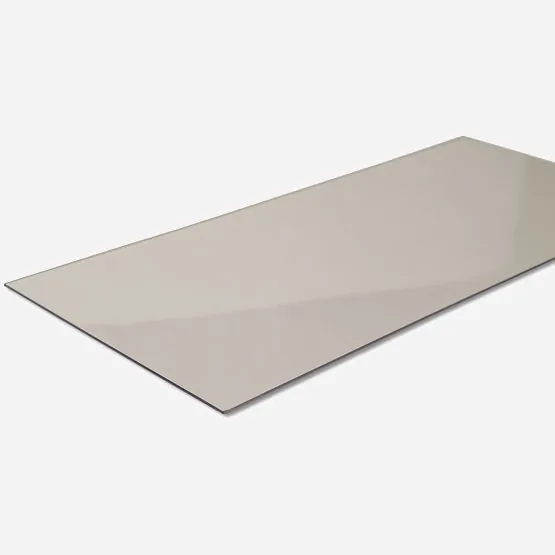
Cut edges
raster engraving
The laser fills an area line by line — like a printer. Ideal for logos and larger motifs. In your file: black filled areas, RGB(0, 0, 0).More in the glossary →vector engraving
The laser traces a line and engraves it into the material — precise, ideal for fine contours. In your file: red hairlines, RGB(255, 0, 0).More in the glossary →Good to know
Description
PET-G is a thermoplastic polyester: completely colourless and highly translucent. It is not meant for long-term outdoor use — under UV it yellows over time. The sheets generally meet class B1 requirements (flame-retardant) and are considered food-safe per FDA and BGA.
PET-G is remarkably impact-resistant (comparable to polycarbonate) and cold-bendable: it bends to any angle without breaking or whitening at the fold.
Thermoform PET-G at 120–160 °C, then let it cool slowly so it settles stress-free into its new shape. It is excellent for vacuum forming.
Lasering
The laser cuts PET-G with a beautifully smooth edge. Engravings are only visible — and only worthwhile — as heavy vector or raster engravings.
Gluing & joining
PET-G bonds well to itself with acetone or dichloromethane; plastic adhesives, contact adhesives, superglue and double-sided acrylate tapes also give clean, transparent joints.
Thanks to its impact resistance you can also nail or rivet PET-G. Screwed joints look great — just avoid countersunk heads.
Uses & environment
Typical applications: displays, stencils, food packaging. PET is recyclable.
Variants & sheet prices
Category: Other plastics
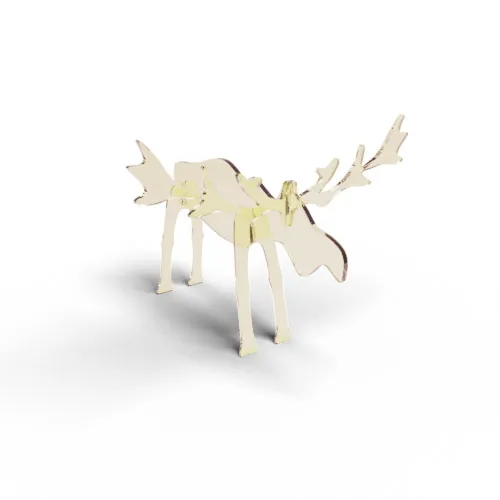
| Color / finish | Thickness | P1 (181 × 181 mm) | P2 (384 × 384 mm) | P3 (790 × 384 mm) | Q (900 × 450 mm) |
|---|---|---|---|---|---|
 colorless, transparent colorless, transparent | 0.5 mm | €1.80 | €6.20 | €11.20 | €14.95 |
Sheet prices incl. VAT. Your cut costs sheet plus laser time — you see the fixed price live when uploading or modelling.
Quick answers
Which thicknesses does PET-G come in?
0.5 mm — 1 thicknesses across 1 variants of colour and finish. You pick the thickness while designing; it drives both price and cutting time.
Which sheet sizes do you cut on?
Four formats: P1 181 × 181 mm, P2 384 × 384 mm, P3 790 × 384 mm, Q 900 × 450 mm. Your design has to fit one of these sheets — larger objects get split into several parts.
What does PET-G cost?
A sheet starts at €1.80 (P1), €6.20 (P2), €11.20 (P3) and €14.95 (Q), each including VAT. What you pay for is the cutting: area, cutting length, engraving, setup and shipping — calculated before you order.
Can PET-G be engraved?
Yes, both as vector engraving and as raster engraving. In your file the colour drives the laser: red hairlines are engraved as lines, black filled areas as surfaces.
Can PET-G be bent?
Yes. PET-G can be bent along a straight line, in thicknesses up to 0.5 mm. You draw the bend line with the “Bend” tool and set angle and radius.
Do I get the whole sheet?
No. You receive your cut parts, not the rest of the sheet. The sheet price is the basis for the calculation, not the scope of delivery.
Related materials
More materials from the same catalogue group as PET-G — for a direct comparison.
Knowledge for this material
- Bending laser-cut parts
Which materials can be bent along a line, why cork, leather and wood are not among them — and how to plan the radius and spacing of your bend lines properly.
- Allowing for kerf
Why laser-cut tab joints wobble even though the drawing is correct — and how to compensate for the kerf in your file.
- Which material thickness
Why 3 mm is the standard, when 5 mm becomes necessary and why thicker material costs disproportionately more.